Introduction
CGPA to percentage conversion is one of the most common academic calculations students need during their educational journey. Whether you’re applying for college admissions, scholarships, government jobs, or private-sector employment, many institutions ask for your percentage instead of your CGPA. Since different universities and education boards use different grading systems, understanding how to convert CGPA into percentage correctly is essential.
In this guide, you’ll learn what CGPA means, how it differs from percentage, the most common conversion formulas, real-life examples, common mistakes to avoid, and answers to frequently asked questions.
What Is CGPA?
CGPA stands for Cumulative Grade Point Average. It is a grading system used by schools, colleges, and universities to evaluate a student’s overall academic performance across multiple subjects or semesters.
Instead of awarding marks out of 100 for every subject, educational institutions assign grade points. The average of these grade points becomes the student’s CGPA.
For example:
- Subject 1: 9 Grade Points
- Subject 2: 8 Grade Points
- Subject 3: 10 Grade Points
- Subject 4: 9 Grade Points
Average = 9.0 CGPA
This system reduces the pressure of focusing only on marks while providing a broader picture of academic performance.
RED MORE: Physics Practical 2019: Complete Guide to Experiments, Preparation, and Exam Success
What Is Percentage?
A percentage represents the marks obtained out of 100. It is one of the oldest and most widely accepted methods of evaluating academic performance.
For example, if a student scores 450 marks out of 500:
Percentage = (450 ÷ 500) × 100
Percentage = 90%
Many universities, employers, and competitive examinations still prefer percentage over CGPA, making conversion necessary.
CGPA to Percentage Conversion Formula
The most commonly used formula is:
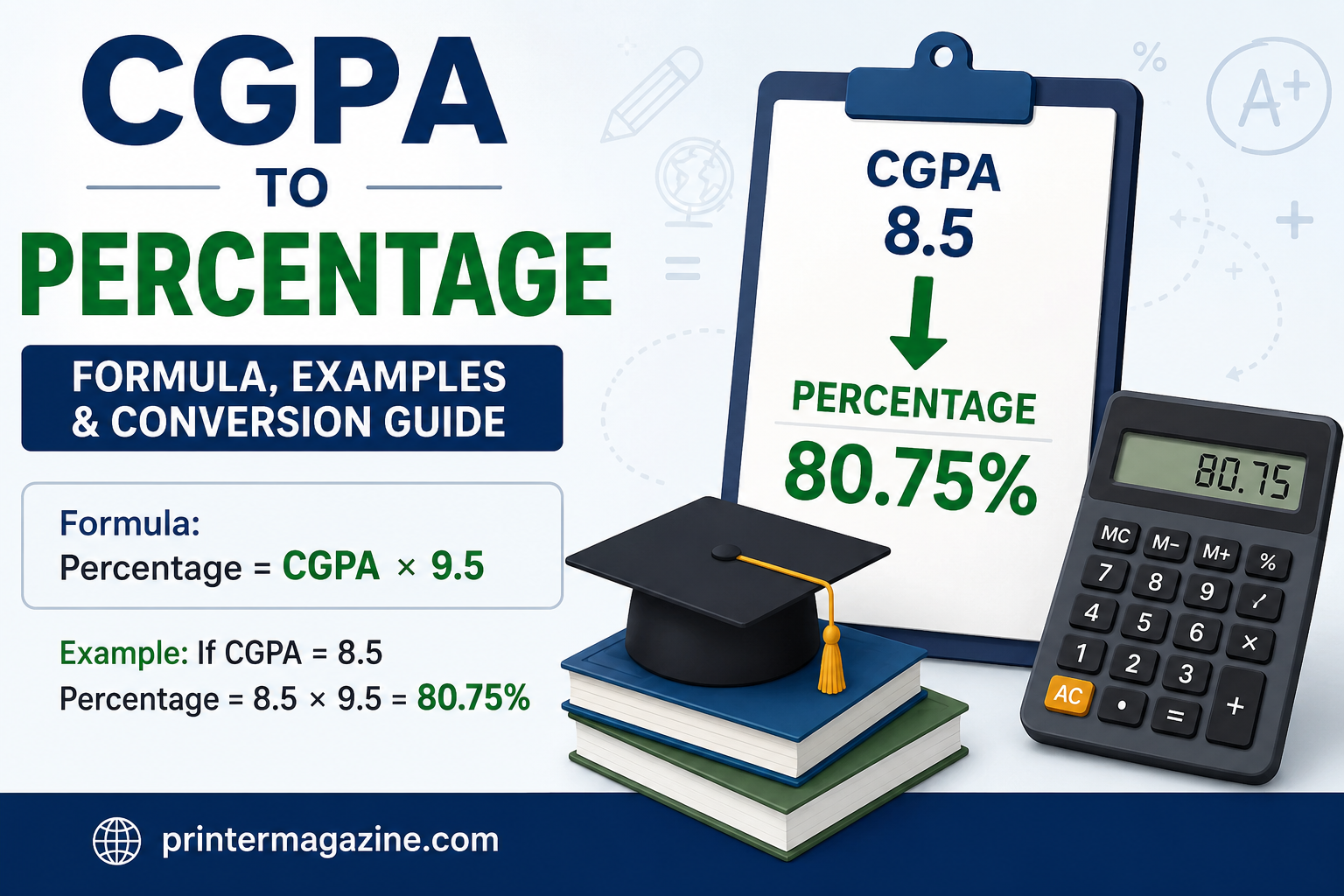
Percentage = CGPA × 9.5
This formula is officially used by many educational boards, including CBSE for its 10-point grading system. However, some universities may follow different conversion methods. Therefore, students should always verify the official formula provided by their institution.
Example 1
CGPA = 8.0
Percentage = 8 × 9.5
Percentage = 76%
Example 2
CGPA = 9.2
Percentage = 9.2 × 9.5
Percentage = 87.4%
CGPA to Percentage Conversion Table
| CGPA | Percentage |
|---|---|
| 10.0 | 95.0% |
| 9.8 | 93.1% |
| 9.5 | 90.25% |
| 9.0 | 85.5% |
| 8.5 | 80.75% |
| 8.0 | 76.0% |
| 7.5 | 71.25% |
| 7.0 | 66.5% |
| 6.5 | 61.75% |
| 6.0 | 57.0% |
| 5.5 | 52.25% |
| 5.0 | 47.5% |
Why Is CGPA Converted into Percentage?
Many organizations still evaluate candidates using percentages. As a result, students often need to convert their CGPA before submitting applications.
Common situations include:
- College admissions
- University transfers
- Scholarship applications
- Government job recruitment
- Private company hiring
- Competitive examinations
Without the correct conversion, applications may be rejected or considered incomplete.
Different Universities May Use Different Formulas
One important thing students should understand is that there is no universal CGPA conversion formula.
Some institutions use:
- CGPA × 9.5
- CGPA × 10
- Institution-specific conversion charts
For this reason, students should always consult their university’s academic guidelines before calculating their percentage.
Difference Between CGPA and Percentage
| CGPA | Percentage |
|---|---|
| Based on grade points | Based on marks obtained |
| Usually measured on a 10-point scale | Expressed out of 100 |
| Easier to compare overall performance | Shows exact marks |
| Common in universities | Preferred in many job applications |
Both systems measure academic achievement but present results differently.
Common Mistakes During Conversion
Many students make simple errors while converting CGPA to percentage.
Some common mistakes include:
- Using the wrong multiplication factor
- Assuming every university follows the same formula
- Rounding numbers too early
- Ignoring official institutional guidelines
- Entering incorrect CGPA values
Double-checking calculations can prevent unnecessary problems during admissions or recruitment.
Practical Example
Imagine two students applying for the same scholarship.
Student A
CGPA = 8.4
Percentage = 8.4 × 9.5 = 79.8%
Student B
CGPA = 9.1
Percentage = 9.1 × 9.5 = 86.45%
The scholarship committee compares their percentages because that is the required evaluation format.
This example shows why accurate conversion is important.
Tips for Students
A few simple practices can help students avoid confusion:
- Always use your official CGPA.
- Verify the conversion formula issued by your institution.
- Keep both CGPA and percentage records.
- Use a calculator for accurate results.
- Check your calculations before submitting applications.
Following these steps ensures that your academic information remains accurate and consistent.
Benefits of Understanding CGPA Conversion
Knowing how to convert CGPA into percentage provides several advantages. Students can complete application forms with confidence, compare academic performance across different institutions, and meet eligibility requirements without confusion.
It also helps when preparing for higher education, professional certifications, internships, and employment opportunities where percentages are mandatory.
A clear understanding of the conversion process saves time and reduces the chances of mistakes.
Conclusion
Understanding CGPA to percentage conversion is an essential academic skill for every student. Although the most commonly used formula is CGPA × 9.5, not every university follows the same standard. Therefore, students should always verify the official conversion method before submitting applications.
Accurate conversion helps during admissions, scholarships, competitive examinations, and job recruitment. By using the correct formula and checking calculations carefully, students can present their academic achievements confidently and avoid unnecessary errors.
Frequently Asked Questions (FAQs)
1. What is the standard formula for CGPA to percentage?
The most common formula is CGPA × 9.5, but some universities use different conversion methods.
2. Is CGPA better than percentage?
Both systems measure academic performance. CGPA provides an overall grade point average, while percentage shows marks out of 100.
3. Can every university use the same conversion formula?
No. Different universities and educational boards may have their own official conversion rules.
4. Why do employers ask for percentage instead of CGPA?
Many employers compare applicants using percentages because it offers a familiar and standardized method of evaluating academic performance.
5. How can I calculate my percentage quickly?
Multiply your CGPA by your institution’s approved conversion factor. If your institution follows the standard method, multiply your CGPA by 9.5.