Introduction
A peptide calculator is one of the most valuable tools for anyone working with peptides, whether in laboratory research, educational settings, or professional scientific environments. Calculating the correct dilution, concentration, and dosage manually can be time-consuming and prone to errors, especially when dealing with very small measurements. A reliable calculator removes the guesswork, helping users determine precise values quickly while improving consistency and reducing mistakes.
Understanding how peptide calculations work is important because even a minor mathematical error can significantly affect the intended concentration of a prepared solution. This guide explains what a peptide calculator is, how it works, why it matters, and how to use it correctly. Along the way, you’ll learn practical examples, common mistakes to avoid, and useful tips that make peptide calculations easier to understand.
| Tool Overview | Details |
|---|---|
| Tool Name | Peptide Calculator |
| Primary Purpose | Calculate peptide concentration, dilution, and solution volume |
| Common Users | Researchers, laboratory professionals, educators, and students |
| Main Benefits | Improved accuracy, faster calculations, reduced mathematical errors |
| Typical Inputs | Peptide quantity, solvent volume, desired concentration |
| Output | Solution concentration or required dilution values |
What Is a Peptide Calculator?
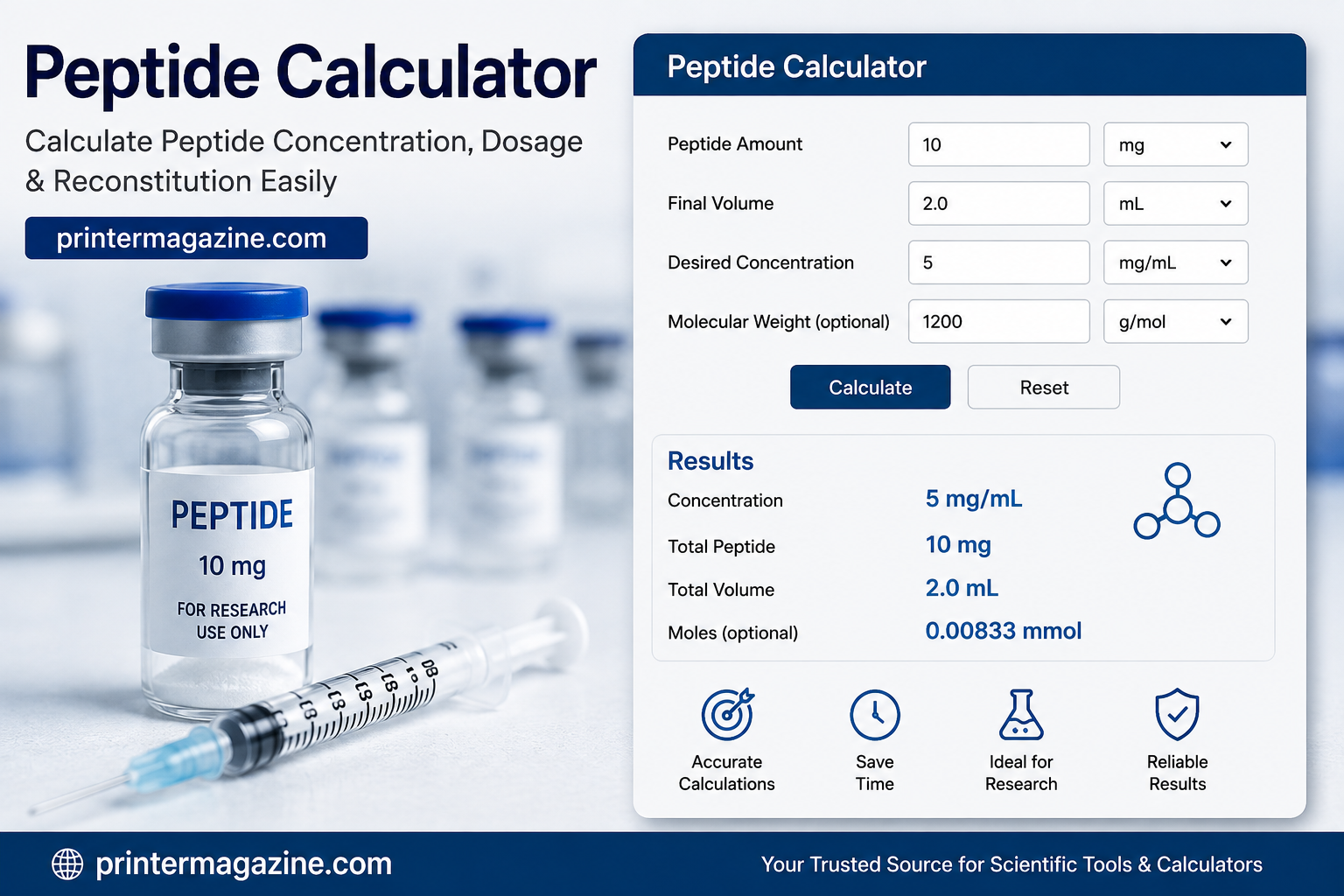
A peptide calculator is a mathematical tool designed to simplify calculations related to peptide preparation. Instead of manually performing multiple conversions, users enter known values such as peptide quantity and solvent volume. The calculator then determines the final concentration or calculates the amount of solvent required to achieve a desired concentration.
RED MORE: Nails: Complete Guide to Nail Care, Health, Beauty, and Maintenance
These calculators are commonly available as web-based applications, downloadable software, spreadsheet templates, or integrated laboratory utilities. Regardless of the format, the objective remains the same: providing consistent and accurate calculations while minimizing human error.
Modern peptide calculators often include additional features such as unit conversion, molecular weight calculations, dilution planning, and concentration adjustments. These capabilities save time while improving workflow efficiency.
Why Accurate Peptide Calculations Matter
Precision is essential whenever solutions are prepared for scientific work. Small numerical mistakes may produce solutions that differ significantly from the intended concentration. Such inconsistencies can influence experimental reproducibility and make results difficult to compare.
Imagine baking bread with twice the required amount of salt. The final product would differ dramatically from the recipe’s intention. Similarly, peptide preparation depends on careful measurements and accurate calculations.
Using standardized calculations also improves communication among researchers. When everyone follows identical mathematical methods, comparing procedures and documenting preparation steps becomes much easier.
How a Peptide Calculator Works
At its core, a peptide calculator applies straightforward mathematical formulas involving mass, volume, and concentration. The user provides known variables, while the calculator determines the missing value.
Typical inputs include:
- Peptide quantity (mg or mcg)
- Desired solution volume
- Target concentration
- Molecular weight (when required)
Depending on the calculator, outputs may include:
- Final concentration
- Required solvent volume
- Amount of peptide needed
- Unit conversions
- Dilution ratios
Although the calculations are relatively simple, automated tools significantly reduce the chance of decimal placement errors or incorrect unit conversions.
Understanding Concentration Calculations
Concentration describes how much peptide is dissolved within a specific volume of liquid. It forms the basis of nearly every peptide preparation calculation.
For example, dissolving 10 milligrams of peptide into 2 milliliters of solvent creates a concentration of 5 milligrams per milliliter.
Changing either the peptide quantity or the liquid volume immediately changes the final concentration. A peptide calculator performs these adjustments instantly without requiring repeated manual calculations.
Understanding this relationship allows users to prepare solutions that meet specific experimental requirements while maintaining consistency across multiple preparations.
Common Units Used in Peptide Calculations
Working with peptides involves several measurement systems. Becoming familiar with these units helps prevent confusion during calculations.
| Measurement | Common Units | Purpose |
|---|---|---|
| Mass | mg, mcg, g | Amount of peptide |
| Volume | mL, L | Amount of solvent |
| Concentration | mg/mL, mcg/mL | Strength of solution |
| Molecular Weight | g/mol | Used for molar calculations |
| Molarity | mM, µM | Scientific concentration measurement |
Many calculators automatically convert between these units, reducing manual conversion errors.
Step-by-Step Example of Using a Peptide Calculator
Suppose a laboratory receives a vial containing 10 mg of peptide. The goal is to prepare a solution with a concentration of 2 mg/mL.
The desired concentration indicates that every milliliter should contain 2 mg of peptide. Dividing the peptide amount by the target concentration determines the required solvent volume.
10 mg ÷ 2 mg/mL = 5 mL
The calculator performs this instantly and reports that adding 5 mL of solvent produces the intended concentration.
This straightforward process demonstrates why automated calculation tools are so widely used in research settings.
Benefits of Using a Peptide Calculator
One of the greatest advantages is consistency. Repeating identical calculations manually introduces opportunities for arithmetic mistakes, especially during long research sessions.
Another major benefit is speed. Instead of calculating formulas repeatedly, users simply enter known values and receive instant results.
Calculators also improve documentation by allowing standardized preparation procedures. This makes reviewing laboratory records significantly easier while reducing ambiguity.
Educational institutions benefit as well. Students can focus on understanding scientific principles instead of spending excessive time verifying mathematical calculations.
Common Mistakes to Avoid
Even with a calculator, incorrect information entered into the fields will produce incorrect results. Accuracy always begins with reliable measurements.
One common mistake involves mixing units. Entering micrograms instead of milligrams changes the result dramatically. Always verify unit labels before calculating.
Another frequent issue is incorrect solvent volume. Measuring liquid inaccurately changes the actual concentration regardless of what the calculator predicts.
Failing to double-check decimal placement can also create major differences between expected and actual values.
Developing a habit of reviewing inputs before accepting results helps minimize these problems.
Factors That Influence Peptide Preparation
Several variables affect the preparation process beyond simple mathematics.
The purity of the peptide influences how much active material is present. Environmental conditions such as temperature may also affect handling procedures depending on laboratory protocols.
Measurement equipment introduces another consideration. High-quality analytical balances and calibrated measuring devices improve accuracy throughout preparation.
Finally, proper documentation ensures that calculations remain reproducible. Recording every preparation step helps maintain consistency over time.
Choosing the Right Peptide Calculator
Not every calculator offers identical functionality. Some focus only on concentration calculations, while others provide molecular weight estimation, dilution planning, and multiple unit conversions.
An ideal calculator should have a simple interface, support common laboratory units, perform automatic conversions, and produce clearly labeled results.
Reliable tools also minimize unnecessary complexity. Users should spend their time preparing solutions rather than interpreting confusing software outputs.
Selecting an intuitive calculator increases efficiency and reduces calculation-related stress.
Real-World Applications
Peptide calculations appear across numerous scientific environments. Academic laboratories frequently prepare peptide solutions for biochemical investigations and educational demonstrations.
Biotechnology companies often standardize preparation procedures to ensure consistency across multiple research projects.
Pharmaceutical research environments may also use peptide calculations during formulation studies and laboratory analysis.
Even classroom teaching benefits from calculation tools because they help students visualize mathematical relationships between concentration, volume, and mass without becoming overwhelmed by arithmetic.
Manual Calculations vs. Digital Calculators
Some experienced professionals still perform calculations manually to verify results or better understand underlying formulas. Manual calculations encourage deeper mathematical understanding and strengthen scientific reasoning.
Digital calculators, however, dramatically reduce repetitive work and improve efficiency during routine laboratory tasks.
Rather than replacing mathematical knowledge, calculators complement it by serving as reliable verification tools.
Many professionals perform an initial manual estimate before confirming the result using a digital peptide calculator.
Best Practices for Reliable Results
Accurate calculations begin with accurate measurements. Always verify the peptide quantity before entering values into the calculator.
Use properly calibrated laboratory equipment whenever possible. Even the best calculator cannot compensate for inaccurate measurements.
Maintain organized records of calculations and preparation details. Clear documentation simplifies future reference and supports consistent laboratory practices.
Finally, review every completed calculation before preparing the solution. Spending a few extra seconds checking inputs often prevents costly mistakes later.
The Future of Peptide Calculation Tools
As laboratory software continues evolving, peptide calculators are becoming increasingly sophisticated. Many modern platforms now integrate calculation features with electronic laboratory notebooks, data management systems, and automated documentation.
Artificial intelligence may eventually provide calculation verification, recommend preparation methods, and identify potential input errors before calculations are finalized.
Cloud-based tools also allow researchers to access consistent calculation methods across multiple devices and locations, improving collaboration between laboratories worldwide.
Despite technological advances, the underlying goal remains unchanged: producing accurate, reliable, and reproducible calculations.
Conclusion
A peptide calculator is far more than a simple mathematical convenience. It is an essential tool that improves accuracy, consistency, and efficiency when preparing peptide solutions. By simplifying concentration calculations, reducing unit conversion errors, and standardizing preparation methods, these calculators help support reliable scientific work.
Understanding the basic principles behind peptide calculations allows users to interpret results with confidence while recognizing potential mistakes before they occur. Whether used in education, biotechnology, or laboratory research, combining careful measurements with dependable calculation tools creates a strong foundation for precise solution preparation. Investing time in learning these concepts ultimately leads to better accuracy, improved workflow, and more dependable outcomes.
Frequently Asked Questions (FAQs)
1. What is a peptide calculator used for?
A peptide calculator helps determine concentrations, dilution volumes, and solution preparation values. It simplifies mathematical calculations while reducing the chance of manual errors.
2. Who commonly uses peptide calculators?
Researchers, laboratory professionals, educators, and students frequently use these tools. They help standardize calculations across scientific and educational environments.
3. Can a peptide calculator perform unit conversions?
Yes. Many calculators automatically convert between common units such as milligrams, micrograms, milliliters, and molar concentrations, making calculations faster and more reliable.
4. Why is concentration important during peptide preparation?
Concentration determines how much peptide is present in a given volume of solution. Accurate concentration supports consistent preparation and reliable experimental procedures.
5. Are manual calculations still useful?
Yes. Manual calculations improve understanding of the underlying mathematics and provide a valuable way to verify digital calculator results before preparing solutions.